New Mural Brings Student Voices to Shields Library
Community engagement at the heart of undergraduate Mural Workshop course
A wall on the first floor of Shields Library has become the canvas for a new mural created by UC Davis undergraduates that emphasizes the importance of keeping knowledge accessible, visible, and honest through collective storytelling.
Located in a large, open study area in Shields’ east wing (at the far end of the first floor from the main entrance), the mural is the stunning finale to a spring quarter project by 13 students in the ART 171/CHI 171 Mural Workshop, a for-credit course taught by Jose Arenas.
Vibrant imagery of students, The California Aggie newspaper, and an oak tree bearing the words “Saber es Poder” (“Knowledge is Power”) are among several elements that explore the library as a space where preservation and empowerment meet.
Arenas, who did graduate work under UC Davis Professor Emeritus of Chicana/o/x Studies Malaquías Montoya, sees the library mural as a full-circle moment.
“Working with Montoya opened my eyes to what community art can represent,” said Arenas, instructor and director of Taller Arte del Nuevo Amanecer (TANA). “This design reflects the artists coming together as a group, engaging with fellow students and leaving their mark here — their stories.”
The idea for the mural sprang from feedback the library gathered as part of a strategic plan priority of making its spaces more inclusive and welcoming. It’s the latest in a series of community-driven initiatives that reflect the library’s evolution into a “third place” for the UC Davis community, beyond home (first) and class or work (second).
“Art matters. It’s not merely decorative; it invites curiosity, reflection and discovery — exactly the kinds of habits a great research library should cultivate,” said Bill Garrity, university librarian and vice provost. “Having a mural created by student artists is a profound contribution to our goal of making the library a place that supports not only academic success, but also belonging, inspiration and connection.”
Location selection
Planning for the mural project began earlier this year with conversations between Arenas and library staff about the mural’s location and broad themes.
Ultimately, the expansive white wall facing the large first-floor study area was selected as the mural’s location, framed by windows on both sides, and a view of the library courtyard and its Turkey oak.
The natural light and the opportunity to create a work that would set the tone for a prominent and popular student-centered space made the choice clear.
“The space kept calling me,” said Arenas.
Community engagement
Community engagement centers the mural process, establishing a connection between the mural workshop students and the diverse community that uses Shields Library, including students, faculty, staff and library employees.
Student artists conducted outreach at an engagement station in the Shields lobby and met with library managers early in spring quarter, inviting input on the values, stories, symbols and themes that represent the library community. The feedback was used as the primary source material for the mural’s conceptual development.
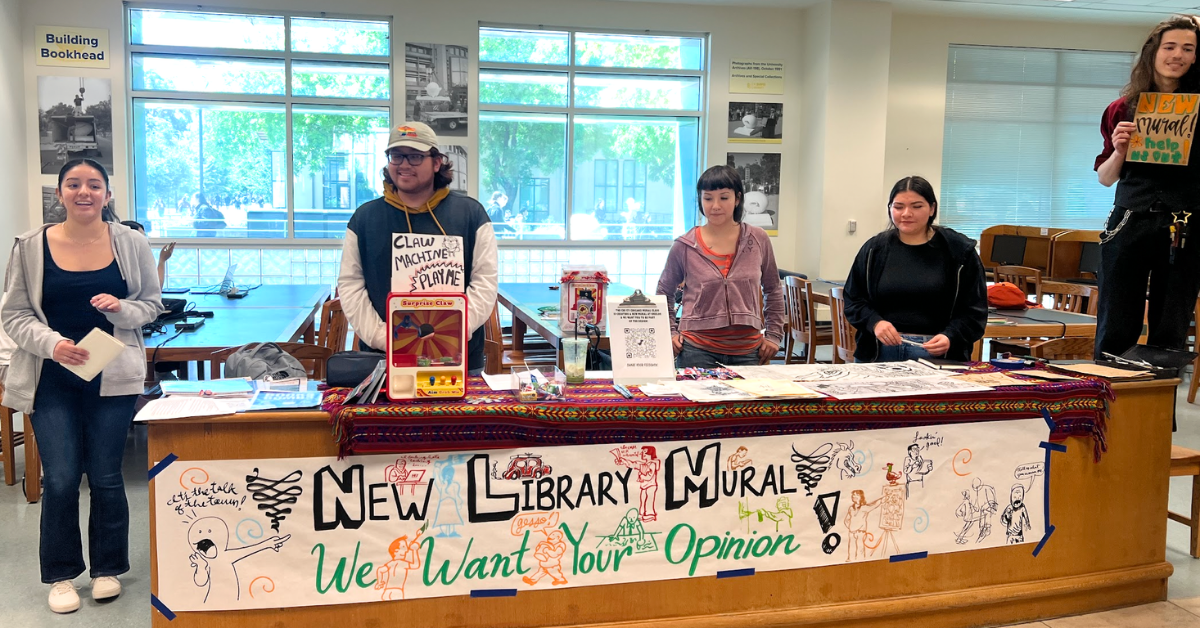
“When students see this mural, I want them to feel represented and heard,” said Brandon Cortes Cardenas, a third-year undergraduate double majoring in art studio and Chicano/a/x Studies. “It’s like, this is my community. I’m here.”
Scaling heights and creating #inreallife
Once the concept was approved and the student artists completed safety training, they took to the study wall, using scaffolding and ladders to create the 11-foot high floor-to-ceiling work.
With Arenas’ guidance, they prepped the space and painted a grid to map out the location of each element before outlining and filling individual sections using acrylic paints. The students also incorporated a silkscreen component using parachute cloth.
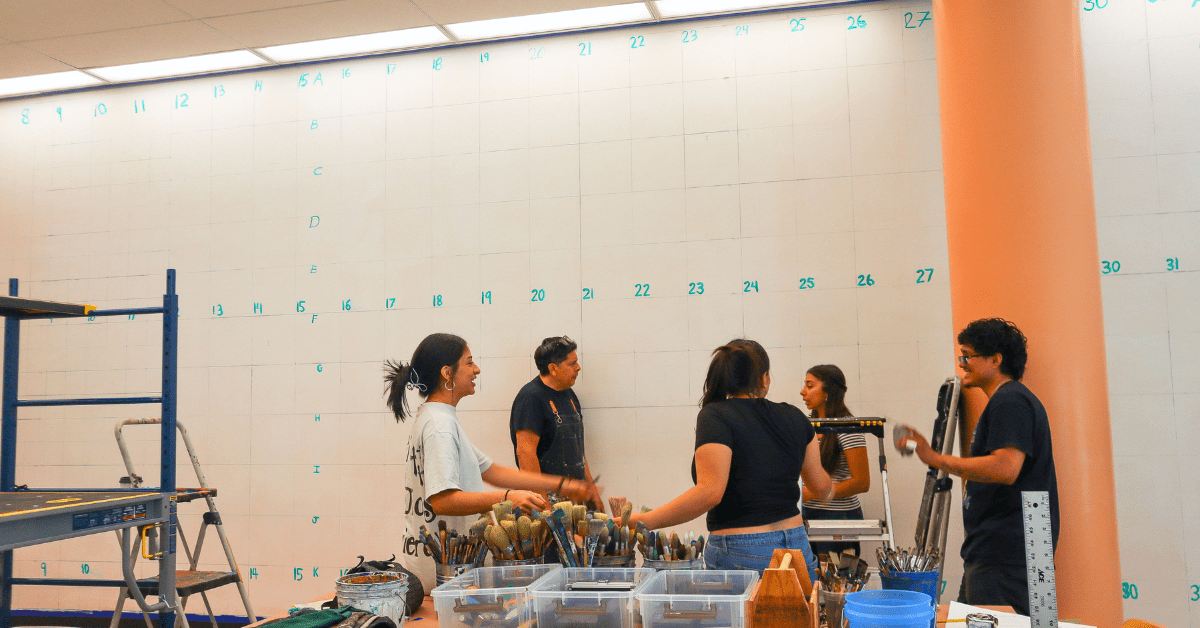
Students using the study space over the last few weeks of the quarter were treated with a live art performance, as the mural revealed itself a bit more each day.
“I can’t wait to see all of it in color, brought to life, by students, for students,” said Cortes Cardenas. “I’m leaving a legacy for other generations.”
Layers of meaning
Learn more about the symbols and patterns portrayed in the mural, as described by the class:
Our purpose in creating this mural is to highlight the stories and experiences of students, and emphasize the importance of collective strength through storytelling. Elements of nature, including the oak tree, ground the composition in resilience, growth, and the enduring presence of community across generations.”
— ART 171/CHI 171 Mural Workshop Participants
The Grito (left figure)
A cathartic shout or yell in Chicano and Mexican culture represents a deeply ingrained expression of cultural identity, pride, joy, and survival. It acts as a unifying vocal tradition rooted in history and emotional release.
Newspapers
Stacks of The California Aggie dispersing outward through the grito suggest the spreading of ideas, student voices and calls for action.
Tonantzin’s Serpent (Pattern abstraction)
Associated with the earth goddess Coatlicue, these fanged serpents represent the duality of life, death, and regeneration. The pattern symbolizes the ability to move between the earth and the cosmos, serving as a reminder of healing and transformation. It honors the way communities rebuild and reclaim knowledge even in the face of erasure.
The Oak Tree
A living symbol at the heart of the library, the oak represents knowledge rooted in land, memory, and the community. It honors the Patwin people and their ancestral connection to this site, standing as a testament to Indigenous resilience against erasure. Like stepping stones for the future, its roots ensure that the histories and spirits of this land continue to guide and empower those who follow.
Students (on tree)
Centering student and community engagement through the image of the tree, we exercise curiosity and imagination to show how preserving knowledge heals the spirit.
Flowers of Nahui Ollin
Representing the central Nahua (Aztec) symbol for the “Fifth Sun” or “Four Movements,” showing the center of the universe and the four directions. This connects to our mural because it represents unity and the connection between people and the world around us. The flower is centered and spreads outward, symbolizing connection and the importance of culture and community.