Sipping History: Rare Book Gifted to the Library
Tea, coffee, and chocolate offer a microcosm of world history
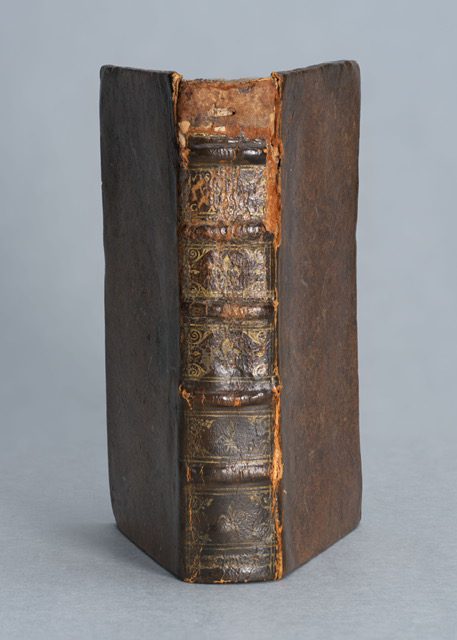
Rain or shine, morning or night, among tea, coffee, and chocolate, there will always be something to satisfy a thirsty palate. Today, these beverage options are as commonplace as the shops on every corner that sell them. However, a recently donated book, facilitated by president of Hacienda La Minita and rare book collector Russ Kramer, reminds us of the long journey these products have traveled since their introduction to the Western world.
Le bon usage du thé, du caffé, et du chocolat pour la preservation et la guerison des maladies, published in 1687, offers a window to the historical reputation of tea, coffee, and chocolate. Written in French by Nicolas de Blégny, Le bon usage was a revolutionary work as it grouped the three foodstuffs together for the first time, linking their lands of origin – Arabia, Asia, and South America – in the European consciousness.
When the book dealer in New York brought it out to me, it was almost like someone saying, ‘Oh, you’re looking for the Holy Grail? Here you go.’”
—Russ Kramer, describing his discovery of the book
Tea, Coffee, and Chocolate in the Ancient World
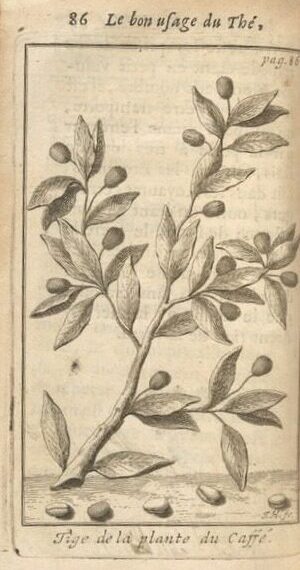
The socioeconomic climate in which Le bon usage was written was colored by transition. The 17th century bridged the Renaissance’s period of classical revival with the scientific Enlightenment era. At the same time, the global center of commerce definitively shifted from the Mediterranean to the Atlantic after the European realization of the Americas in the late 15th century.
By the turn of the 16th century, both tea and coffee had already been introduced to Europe for nearly a hundred years and had trickled past elite circles into the general populace. Le Procope, Paris’ oldest cafe, opened in 1686, and soon other similar enterprises were flourishing as well.
Chocolate, during this time, was Europe’s latest newcomer. Initially, it didn’t stray far from its Aztec origins, where it was taken as a drink to heighten endurance and strength. Mimicking this practice, Europeans considered chocolate medicine, but replaced the original recipe’s inclusion of chilis with sugar. Chocolate was used in a variety of royal courts in this way, gaining the additional reputation as an aphrodisiac before evolving into the familiar pleasurable indulgence of today.
Nicolas de Blégny was a French author and practitioner of chemical medicine who entered the royal court of King Louis XIV despite his lack of a noble or university background. Outspoken in his rejection of the University of Paris’ dominant classical approach to medicine of the time, Le bon usage exemplifies Blégny’s innovative nature through his elevation of the health benefits of chocolate, coffee, and tea. On account of his position, the text offers an unparalleled view into the intellectual and cultural climate of the 17th century for modern audiences.
Books as Historic Works in a Digital Age
The word manuscript, used colloquially now to refer to any written document an author submits into the publishing process, originally derives from the Latin manus scriptus, or written by hand. Today, in a digital age, physical books are pushed progressively further to the wayside, but it is imperative to consider how their corporeality offers insight.
Books can provide knowledge on three levels, explains Christine Cheng, who leads instruction and outreach in the UC Davis Library’s Archives and Special Collections.
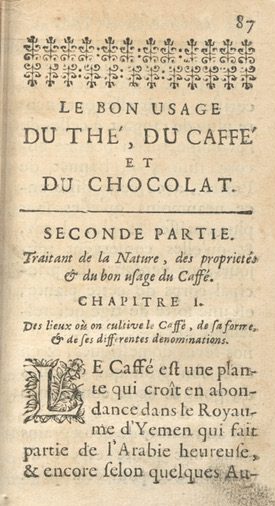
First, there is the book’s written contents: the subject of the text that allows a modern audience to experience history in a microcosm. Second, there is the physical text itself: its format unveils additional layers of nuance. For instance, pagination – such as a table of contents or indexes – is a modern invention for organization. Lastly, the materiality of the book enriches historical knowledge: the book’s binding, the page material, and handwritten or printed text all reveal clues about approaches to and beliefs about recorded knowledge in any given era.
An example of this depth within Le bon usage is how the book’s typescript uses the “long s,” ſ, rather than the lowercase “s” familiar to readers today. Historically, the “long s” was a holdover character from classical handwritten texts. In the transition to the printing press in the 16th century, words were formed by individual one-letter stamps that had to be hand-slotted together. The speed and handling required during this process made the “long s” a nuisance, as its shape was fragile and prone to breaking. Eventually, in the 18th century, the letter was phased out for the “s” we recognize today.
Research in the Archives
Le bon usage offers a wealth of potential applications for many fields and disciplines across campus, from the classroom to personal research.
According to Cheng, interaction with such books “makes history come alive” for students. It allows them to connect the physicality of one’s world to the past, making it easier to conceptualize its contents. Furthermore, the book’s period-specific details offer students opportunities to develop critical thinking and analysis skills.
Claire Goldstein, UC Davis Humanities Program Director, professor of French and author, sees special potential in Le bon usage in relation to her research in ancien régime, the history of the Kingdom of France before the French Revolution in 1789.
Currently, Professor Goldstein’s focus is on Nicolas de Blégny as an erased figure in French history, the result of the many power struggles he faced in court politics. The death of information about Blégny gives Le bon usage a crucial level of importance in Professor Goldstein’s efforts to bring him into the light.
Researchers from various disciplinary perspectives, from food studies to plant sciences and beyond, will find value in this rare book, now the fourth-oldest book on coffee in the library’s collections. Housed in the library’s Archives and Special Collections, it can be viewed upon request.