Library Research Travel Grant Recipient Benjamin Prostine on the Labor History of Dairy Farming
The UC Davis Library awarded five scholars a $2,500 research travel grant in 2026 to support use of our distinctive collections in Archives and Special Collections and Food and Drink. Grant recipient Benjamin Prostine shares his research experience below.
For a week and a half in September, I conducted archival research at the UC Davis Library for my dissertation project: “Milked: Land, Labor, and Livestock in the Twentieth Century Dairy Industry.” This project is an animal and labor history of dairy farming in the United States, a cow-centric narrative that tells the story of what it has meant to be a dairy cow under capitalism.
A crucial part of my research is the emergence of large-scale dairy farming in California. While historical scholarship on California agriculture is abundant, the dairy industry remains a neglected topic even though California is the largest producer of milk in the country and dairy products generate more revenue than any other agricultural crop in the state. With an abundance of rich materials on this topic, the Archives and Special Collections Department at the UC Davis Library has played a critical role in moving this project forward.
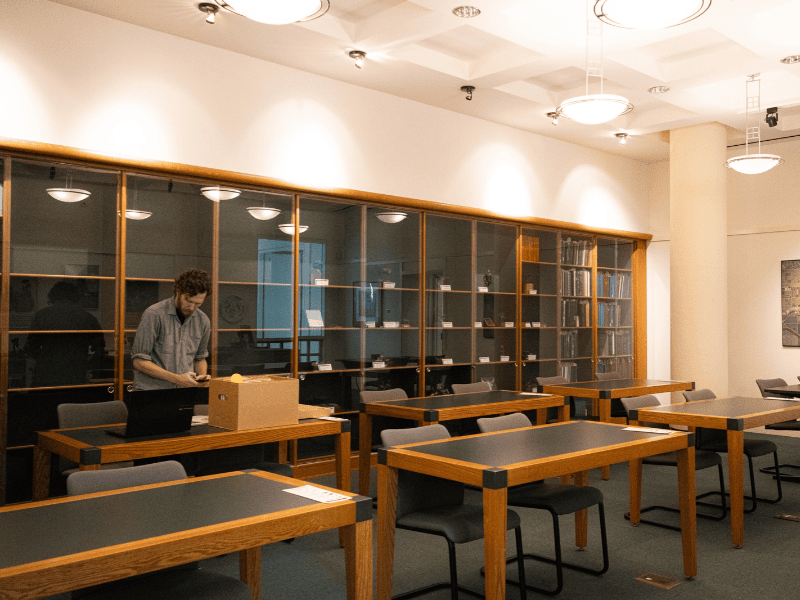
The records of the Sunshine Farm Dairy, the most extensive archival collection of a dairy farm I have encountered in my research, became the main focus of my trip. Operated by E.E. Greenough, Sunshine Farm Dairy milked cows in the San Joaquin Valley for over half a century. Through letters and production records, this collection provides an intimate portrait of the development of large-scale dairy farming. While the farm counted less than 10 cows at the end of the First World War, the herd grew to over 600 cows by the late 1960s when Greenough retired and sold the herd.
This massive expansion of the farm was not all blue skies and sunshine: Greenough struggled with labor issues, cattle diseases, and the economic pressures to cheaply produce more and more milk. In his quest to find solutions to the problems of industrial dairying, Greenough—an avid letter writer—wrote to other dairy farmers, politicians, agricultural researchers, and equipment and feed companies. As Greenough wrote in 1963, “Competition is getting so keen that every thing that contributes to the saving of labor and expense must be utilized.” This might mean optimizing feeding systems—feed was the biggest expense for most California dairies—but also getting involved with union-busting efforts like the failed campaign to turn California into a right-to-work state in 1958.
Through the records of the Sunshine Farm Dairy—along with the excellent records on dairy technologies and farm labor in the Floyd Halleck Higgins Collection—I now have the narrative glue to analyze a pivotal period in the growth of large-scale dairy farming.”
— Benjamin Prostine
I came to Davis with a void in my research project—a gap between my chapter on feedlot dairy farming in Los Angeles County during the Great Depression and my chapter on the expansion of environmental and farm labor regulations in the 1970s—but left with firm foundations for a chapter on what happened in between. This chapter will analyze dairy farming through the lens of labor and ecology, exploring the interconnections between dairy automation, labor conditions, feedlot systems, and cattle diseases like mastitis.
The UC Davis Library Research Travel Grant has given me the opportunity to access the necessary materials to tell this story. I look forward to sharing the fruits of this research through academic publications, conference presentations, public-facing writing and, ultimately, a book on the history of the mega dairy.