Chat Chat Episode 3.1: Carpathian (Ukrainian) Tea Culture
Listen to the Episode
Discuss tea culture in the Carpathian Mountains of Ukraine with Nina Fontana and Nadia Tarnawsky.
Recorded: March 22, 2022 via Zoom
About the Episode
Guest bios
Nina Fontana is a member of the inaugural 2021-2022 “Future of Fire” cohort in the CASCNetwork Climate Adaptation Postdoctoral Fellows Program. She is a postdoctoral researcher at the University of California, Davis in collaboration with the USGS Southwest Climate Adaptation Science Center.
Using both qualitative and quantitative methodologies, Nina’s research centers on traditional ecological knowledge (TEK) in forest-dependent communities in the Carpathian Mountains of Ukraine, specifically how TEK nurtures cultural ties to landscape, maintains health of communities, and informs adaptive capacity in supporting regional food sovereignty. Her broader research interests include socio-ecological resilience, translational ecology, Indigenous analysis of climate change, and environmental justice. Nina received her M.S. and Ph.D. in Ecology from UC Davis. Additionally, with 15 years of teaching in both secondary and postsecondary settings, international and nationally, Nina is committed to fostering creativity, inquiry, and critical thinking, both in and out of the classroom. Her current research explores: 1) strategies to address multi-scalar policy barriers and opportunities to implement Indigenous-led traditional burning across land jurisdictions and ecosystems, and 2) the various scales in which Indigenous cultural burning may be applied to address climate change in Southwest ecosystems.
Nadia Tarnawsky has been studying Eastern European singing techniques for over three decades. She spent much of 2017 and 2018 in Ukraine as a recipient of a Fulbright award. She has taught Ukrainian village style singing in workshops for the Ukrainian Catholic University in Lviv, Ukraine, the Center for Traditional Music and Dance in New York city, Village Harmony in Vermont and Oregon, the Kitka Women’s Vocal Ensemble in San Francisco, and the Dunava Ensemble in Seattle among others. In 2011 she received a Traditional Arts Fellowship from Artist Trust and an Artist Support Residency from Jack Straw Productions. In 2002 she received a Foreign Language and Area Studies Fellowship which allowed her to travel to Ukraine to collect folk songs and folklore. She sang under the tutelage of Yevgeny Yefremov with Ensemble Hilka of New York in commemoration of the 25th anniversary of the Chornobyl disaster in Ukraine. A recording of this repertoire was released on the Smithsonian Folkways label. Dr. Nina Fontana, Ecologist Nadia Ternawsky, Singer. Photo by Daren Stahl
The episode
Our podcast starts with identifying tea cultures exist outside of cultures we may traditionally associate with “tea culture”. This podcast discusses the Hutzul communities in the Carpathian Mountains in Ukraine and how tea is a way of life and the direct connect of the community with their environment by using local herbs and fruits like mulberry or hawthorn.
Nina and Nadia both discovered teas and tisanes in a medicinal role, they later came to enjoy teas for flavor and recognized
“tea as a great connector among people”
Nadia professionally recognizes tea as a singer and “tea is the rosin for my bow”
The Global Tea Initiative embraces teas and tisanes (infusions that are not strictly Camellia sinensis)
Nina suggest two tea cultures exist in Ukraine and the Carpathian Mountains (made of very diverse cultures and ethnographic groups) and specifically in context of the Hutsul populations:
- Tea as medicine in town/pharmacy
- Tea as social instrument for occasions
Nadia relates a story of having a cold in Ukraine and being told to try a black radish filled with honey to address the illness. Nina mentioned common blends would include bilberry often mixed with local ingredients like lemon balm, raspberry leaves, yarrow, rosehips or wild thyme.
“If you were to really take a look at the ecosystem you would understand how deeply connected personal health is to the ecosystem…”
A snapshot of daily life, Nadia relates a unique time which is around Christmas, Jan. 6 – 19th where there is perpetual feast and songs all the way through midnight and music rising through the mountain. Nadia recalled enjoying this time of quiet with tea hearing the music in the distance from a candlelit cemetery.
While Nina stayed, it is very rare for anyone to be by themselves, everyone knows each other in the community. Music and socializing is a big piece of the community. Nadia mentioned tourism is a big industry in the area and they were doing
“Air BnB before Air BnB was around… There was always tea involved.”
“At the end of your day you would have your tea and go out in the mountains to hear people make music”.
Nina focused less on music but on how different cultural groups steward their forest and looking at different impacts like pollution, immigration and other factors. Focused not just on the region, but the people as well. Nadia pointed out that the middle generation often leave Ukraine to find work and use Euro-tending countries to help support families in Ukraine.
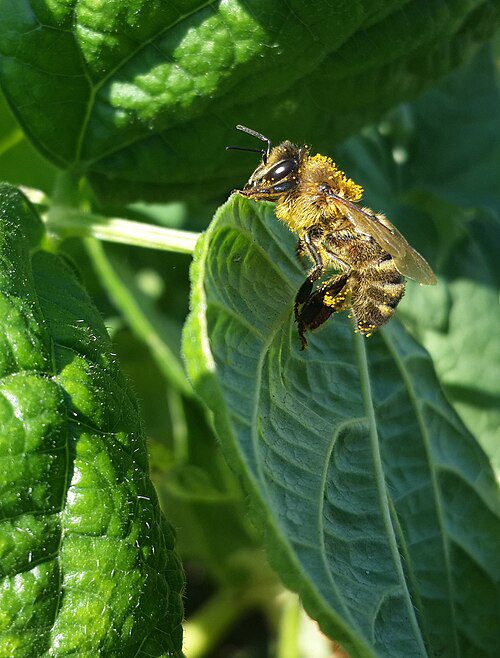
There is a carpathian bee specific to the area, and honey is a big deal, but teas are not overly honeyed (and it is self-regulated) compared to bubble tea.

Discussion continued about how tea culture has been impacted by more recent events. First, Covid-19, which the community was mostly protected by geographical isolation despite being a population with very little social distance in everyday interactions. One of the bigger challenges was transit and storage of vaccines for these communities.
Of more recent events, the Russian invasion of Ukraine. How does war and turmoil effect these communities and ecology? Large impact is the influx of populations coming through to escape the war. This isn’t considered a burden in these communities because there is a kindred spirit, or need, to help their own people. An important point is that Ukraine has weathered so much war and destruction. Nina and Nadia worked right along the WW2 Russian front in this carpathian community in Ukraine. Nadia related a story of an 85 year old woman that has helped her with music saying this has happened before and hoped it wouldn’t happen again, but they’ll make it through this, too. Nadia also related the profound nature of a photo in the New York Times where amongst the devastation is the WW2 memorial where Ukraine faced similar devastation. Nina closed with:
“They’re still going to be drinking tea, because that’s what we do. Tea is part of healing as well”
Nadia pointed out that for support packages, tea is always on the list. Nadia and Nina both recommend for those that want to donate to Ukraine communities during this time of war, can donate to World Central Kitchen.
Nina’s point of clarification:
Moss vs. Lichen: Icelandic moss is really a lichen. In the video, Nina says that this moss isn’t a plant. What she means is that Icelandic Moss is a misnomer and it is in fact a lichen! Icelandic moss isn’t a moss and therefore isn’t a plant since lichens are not plants. Lichens are a symbiotic partnership of two organisms: a fungus and an algae.
Music for this podcast
Shadows of Our Forgotten Ancestors. Music direction by Alexander Fedoriouk. Cleveland, OH: Folk Sounds Records, 2001.
- Vasyl Geker, violin
- Alexander Fedoriouk, cimbalom, buben
- Andrei Pidkivka, sopilka, tylynka
- Nadia Tarnawsky, vocals
- Mykola Kuzyk, trembita

Cha Chat is dedicated to the Global Tea Initiative
The Global Tea Institute (GTI) promotes evidence-based knowledge about tea. It is a singular global phenomenon, a neutral place for multidisciplinary tea scholarship.